

Artificial Intelligence has evolved far beyond generating text. Today, the real competitive advantage lies in an AI system’s ability to retrieve the right information at the right time.
This is why Vector Databases have become one of the most important components of the modern AI technology stack.
Whether you’re building enterprise chatbots, AI assistants, recommendation engines, or Retrieval-Augmented Generation (RAG) applications, understanding vector databases is now an essential skill for every AI developer.
Why Traditional Search Falls Short
Traditional relational databases and keyword-based search engines are excellent at finding exact matches. However, AI applications require much more than matching words—they need to understand meaning, intent, and context.
Example
User Query:
“How can I reduce cloud costs?”
A traditional keyword search might fail to retrieve documents titled:
- Optimizing AWS Infrastructure
- Resource Cost Management
- Cloud Spend Optimization
Although none of these documents contain the exact phrase “reduce cloud costs,” they all discuss the same concept.
A Vector Database successfully retrieves these documents because it searches using semantic similarity rather than exact keyword matching.
What is a Vector Database?
A Vector Database stores vector embeddings, which are numerical representations of text, images, audio, or other data generated by AI embedding models.
Instead of indexing only keywords, these embeddings capture the semantic meaning of the content.
This allows AI systems to:
- Understand context instead of exact wording
- Find semantically similar information
- Rank results based on relevance
- Retrieve information within milliseconds
- Scale efficiently across millions of records
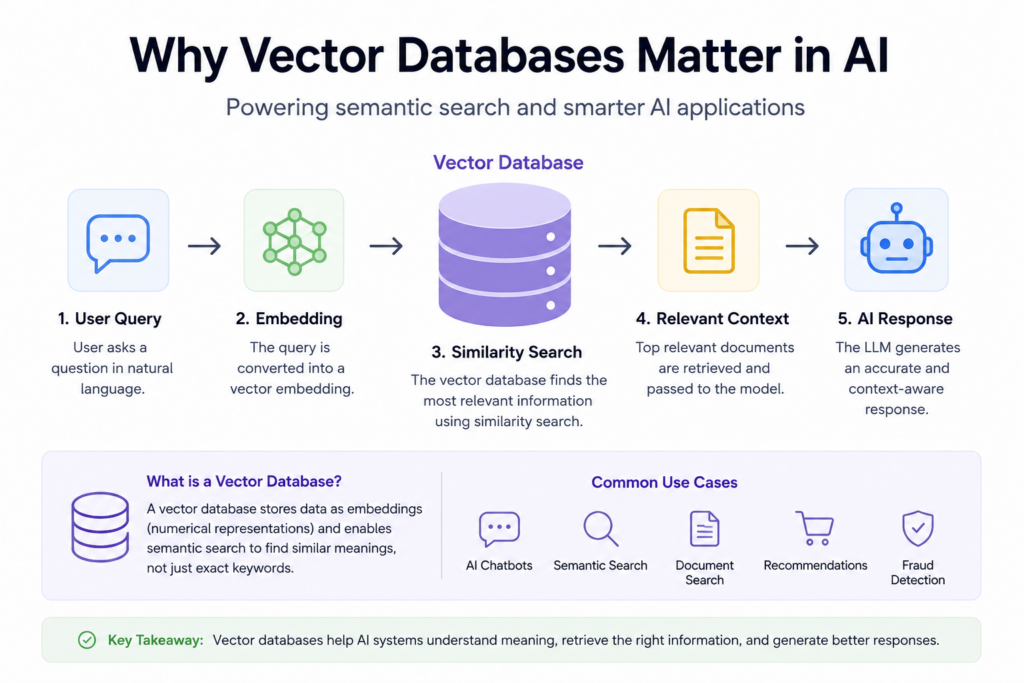
How Vector Databases Work
The workflow is straightforward yet incredibly powerful.
- A user submits a query.
- The query is converted into a vector embedding.
- The Vector Database performs a similarity search.
- The most relevant documents are retrieved.
- The Large Language Model (LLM) uses the retrieved context to generate an accurate response.
This architecture is commonly known as Retrieval-Augmented Generation (RAG).
Why Vector Databases Matter in AI
Large Language Models such as GPT, Claude, and Llama are trained on enormous datasets. However, they do not automatically know your organization’s latest documentation, internal policies, product manuals, or proprietary knowledge.
A Vector Database bridges this knowledge gap.
Instead of relying solely on what the model learned during training, the AI retrieves the latest and most relevant information from your organization’s knowledge base before generating an answer.
The benefits include:
- More accurate AI responses
- Reduced hallucinations
- Access to real-time organizational knowledge
- Improved customer experience
- Better enterprise search capabilities
Common Use Cases
Vector Databases are rapidly becoming the standard solution for numerous AI-powered applications.
Some of the most common use cases include:
- Enterprise AI Assistants
- Customer Support Chatbots
- Knowledge Management Systems
- Semantic Document Search
- Recommendation Engines
- Fraud Detection
- Anomaly Detection
- Personalized Content Delivery
- Legal Document Search
- Healthcare Information Retrieval
Popular Vector Database Technologies
Several platforms have emerged as leaders in the vector database ecosystem.
Pinecone
A fully managed vector database designed for production-scale AI applications with excellent scalability and performance.
Weaviate
An open-source, AI-native vector database that supports semantic search and integrates easily with modern AI frameworks.
Milvus
A high-performance vector database optimized for large-scale similarity search across billions of vectors.
pgvector
A PostgreSQL extension that enables vector search directly within existing PostgreSQL databases, making it an excellent choice for organizations already using PostgreSQL.
ChromaDB
A lightweight and developer-friendly vector database ideal for AI prototypes, experimentation, and local development.
Vector Databases vs Relational Databases
One common misconception is that Vector Databases replace traditional relational databases.
In reality, they solve entirely different problems.
| Relational Database | Vector Database |
|---|---|
| Exact match queries | Semantic similarity search |
| Structured data | Embeddings and unstructured data |
| SQL operations | Nearest-neighbor search |
| Transactions | AI knowledge retrieval |
Modern AI applications often combine both technologies to deliver the best performance and accuracy.
Final Thoughts
Vector Databases have become a foundational technology for modern AI systems.
As AI applications increasingly rely on contextual knowledge and semantic understanding, traditional keyword search is no longer sufficient. Vector Databases empower developers to build smarter, faster, and more reliable AI applications by retrieving information based on meaning rather than exact wording.
For developers working with Large Language Models, Retrieval-Augmented Generation (RAG), or enterprise AI solutions, understanding Vector Databases is no longer optional—it is a core competency that enables the next generation of intelligent applications.