
What Corporate Hiring Can Learn from the Indian Armed Forces’ Officer Selection Philosophy
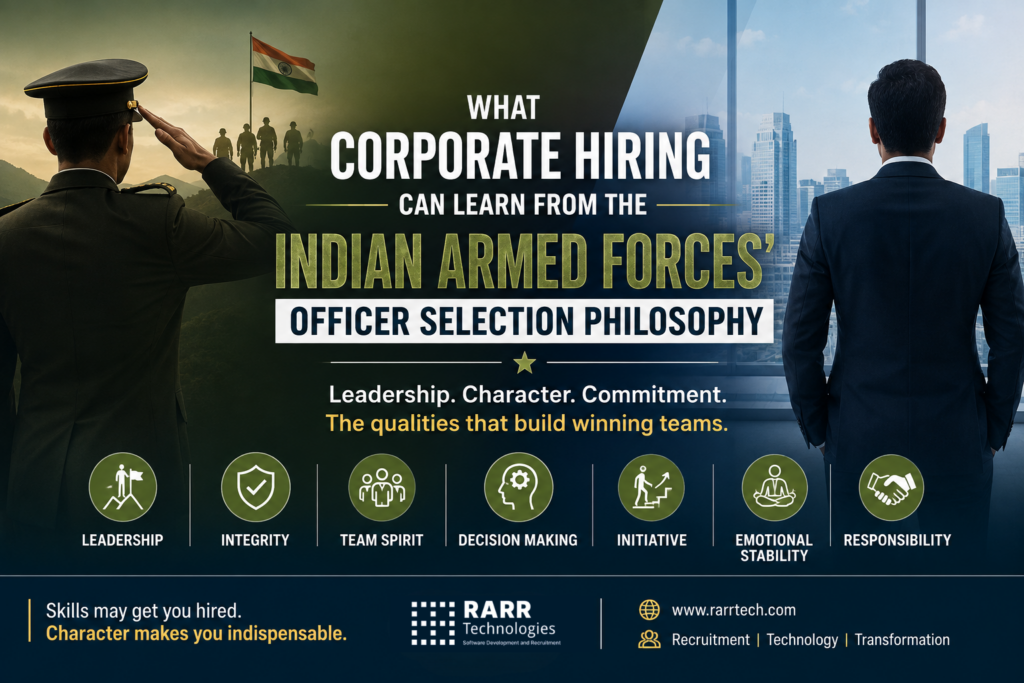
Hiring Has Never Been Easy Every organization wants professionals who are technically competent, dependable, adaptable, and capable of leading teams through uncertainty. Yet, despite advanced hiring tools, structured interviews, psychometric tests, and AI-assisted screening, companies continue to make expensive hiring mistakes. The question is: Are we evaluating the right qualities? Interestingly, one of the most respected leadership selection systems already exists—not in the corporate world, but in the Indian Armed Forces. The Written Examination Is Only the Beginning Every year, thousands of young Indians aspire to become commissioned officers through examinations such as the National Defence Academy (NDA) and Combined Defence Services (CDS). But clearing the written examination does not make someone an officer. It merely qualifies the candidate for the next stage—the Services Selection Board (SSB). Over several days, candidates participate in psychological assessments, group tasks, outdoor leadership exercises, interviews, and team-based problem-solving activities. The purpose is not simply to identify intelligent candidates. The objective is to identify individuals who can lead others, make decisions, work in teams, and perform effectively under challenging circumstances. And that distinction makes all the difference. Skills Are Evaluated. Character Is Observed. The SSB selection philosophy places significant emphasis on Officer Like Qualities (OLQs). These include qualities such as: Effective Intelligence Initiative Reasoning Ability Self-Confidence Sense of Responsibility Decision-Making Courage Communication Team Spirit Emotional Stability Determination Integrity These qualities cannot be fully understood through a résumé. They become visible through behaviour, decisions, consistency, communication, and interactions with others. Perhaps that is why the assessment process extends beyond a conventional interview. Instead of asking only what a candidate knows, it attempts to understand how the candidate thinks, behaves, responds, and works with others. Corporate Hiring Has a Different Bias Most organizations evaluate candidates using parameters such as: Educational qualifications Technical skills Certifications Domain expertise Years of experience Previous job responsibilities All of these are important. But they primarily answer one question: “Can this candidate perform today’s job?” There is another question that is equally important: “Can this individual grow into tomorrow’s leader?” That second question is often harder to evaluate. A candidate may have an impressive résumé but struggle with accountability, collaboration, adaptability, or decision-making. Another candidate may have a less impressive profile but demonstrate curiosity, ownership, resilience, and the ability to learn quickly. This is where traditional hiring can miss potential. The AI Era Demands a Different Hiring Philosophy Artificial Intelligence is changing the workplace faster than many organizations anticipated. Programming languages evolve. Frameworks become obsolete. Tools change. Job roles themselves are being redesigned. In such an environment, hiring solely for today’s technical requirements can become risky. However, qualities such as ownership, judgment, integrity, adaptability, resilience, curiosity, and leadership remain valuable regardless of how technology changes. As technology becomes increasingly accessible, uniquely human qualities can become an even stronger competitive advantage. Organizations that hire only for technical skills may build capable teams. Organizations that also hire for character can build enduring institutions. What Can Corporate Hiring Learn from SSB? Corporate organizations and the Armed Forces serve very different purposes. Their selection systems cannot—and should not—be identical. However, the philosophy behind leadership assessment offers valuable lessons for corporate recruitment. Instead of relying entirely on résumé-based evaluation and conventional interviews, organizations could explore questions such as: Does the candidate naturally take ownership? Do they wait for instructions, or do they proactively identify and solve problems? Can they influence a team without formal authority? Leadership is not always about designation. Sometimes, the strongest indicator of leadership is the ability to influence, collaborate, and bring people together without relying on hierarchy. How do they behave under pressure? A candidate’s response to uncertainty, setbacks, deadlines, and difficult situations can reveal qualities that a résumé cannot. Do they demonstrate integrity when faced with difficult choices? Technical competence can create performance. Integrity creates trust. Are they willing to learn beyond their comfort zone? In a rapidly changing workplace, the ability to learn and adapt can be more valuable than knowing a particular tool today. Hiring for Potential Creates Long-Term Value Throughout my journey in recruitment, I have seen candidates with exceptional technical profiles struggle because they lacked accountability or adaptability. At the same time, I have seen candidates with average résumés outperform expectations because they possessed curiosity, ownership, resilience, and a willingness to learn. This leads to an important distinction: Skills can be taught. Experience grows with time. But character is much harder to develop. That is why hiring should evaluate both competence and potential. A strong recruitment process should not only identify whether someone can perform a role today. It should also provide signals about whether that person can grow, adapt, take responsibility, and contribute meaningfully tomorrow. From “Can They Do the Job?” to “Can We Trust Them With Responsibility?” The future of hiring may not be about replacing technical assessments with behavioural assessments. It may be about combining both. Technical skills tell us whether a candidate can perform specific tasks. Behavioural and leadership assessments can help us understand how that candidate may respond when the situation becomes uncertain, difficult, or unfamiliar. The strongest hiring decisions therefore consider both: Competence + Character Skills + Potential Experience + Adaptability Performance Today + Leadership Tomorrow Final Thoughts The Indian Armed Forces have refined their officer selection philosophy over decades to identify individuals capable of leading under demanding circumstances. Corporate hiring does not need to replicate that process. But it can certainly learn from its underlying philosophy. Perhaps the future of recruitment lies not only in asking: “What skills does this candidate possess?” but also: “Can this person be trusted when the responsibility is theirs?” Because great organizations are not built merely by skilled professionals. They are built by people whose character inspires confidence long before their résumé does. The Hiring Question Worth Asking Before making your next hiring decision, ask yourself: Are we hiring only for what the candidate can do—or also for who the candidate can become? Rohit Gulati August 17, 2026