atsMantra

Welcome to the atsMantra knowledge hub. Discover expert articles, practical guides, and industry insights on AI-powered recruitment, Applicant Tracking Systems (ATS), resume parsing, candidate matching, hiring automation, recruitment technology, and talent acquisition strategies. Learn how atsMantra helps recruiters and organizations streamline hiring, improve candidate experiences, and make faster, data-driven recruitment decisions.

Recruitment Insights Reading Time 7 Minutes
atsMantra, HR Recruitment, Human Resources

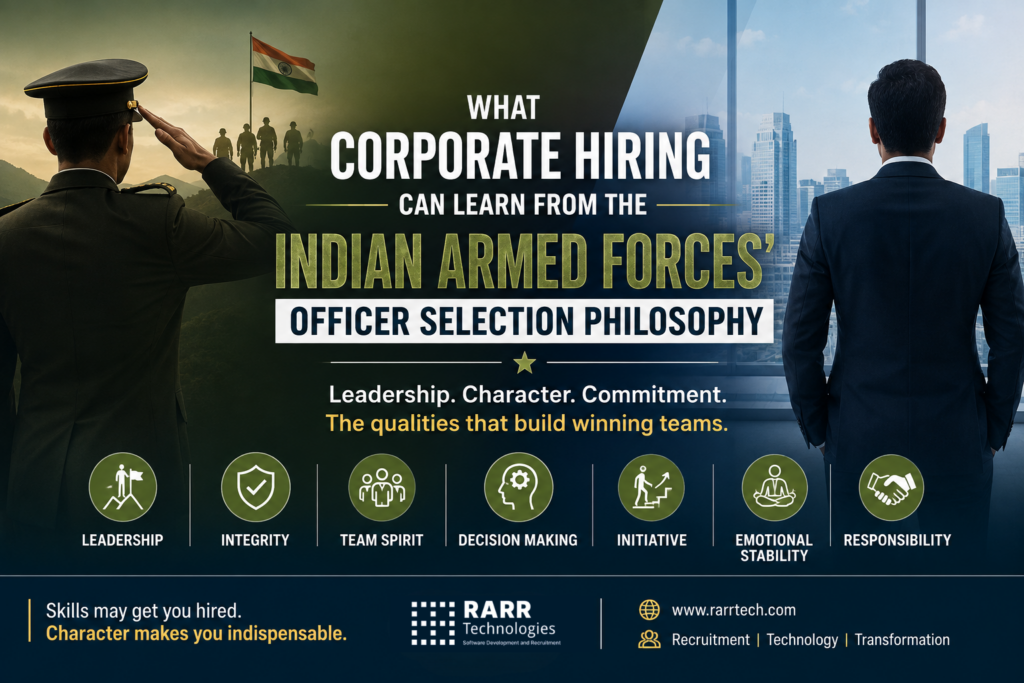
What Corporate Hiring Can Learn from the Indian Armed Forces’ Officer Selection Philosophy

Hiring Has Never Been Easy Every organization wants professionals who are technically competent, dependable, adaptable, and capable of leading teams through uncertainty. Yet, despite advanced hiring tools, structured interviews, psychometric tests, and AI-assisted screening, companies continue to make expensive hiring mistakes. The question is: Are we evaluating the right qualities? Interestingly, one of the most respected leadership selection systems already exists—not in the corporate world, but in the Indian Armed Forces.   The Written Examination Is Only the Beginning Every year, thousands of young Indians aspire to become commissioned officers through examinations such as the National Defence Academy (NDA) and Combined Defence Services (CDS). But clearing the written examination does not make someone an officer. It merely qualifies the candidate for the next stage—the Services Selection Board (SSB). Over several days, candidates participate in psychological assessments, group tasks, outdoor leadership exercises, interviews, and team-based problem-solving activities. The purpose is not simply to identify intelligent candidates. The objective is to identify individuals who can lead others, make decisions, work in teams, and perform effectively under challenging circumstances. And that distinction makes all the difference.   Skills Are Evaluated. Character Is Observed. The SSB selection philosophy places significant emphasis on Officer Like Qualities (OLQs). These include qualities such as: Effective Intelligence Initiative Reasoning Ability Self-Confidence Sense of Responsibility Decision-Making Courage Communication Team Spirit Emotional Stability Determination Integrity These qualities cannot be fully understood through a résumé. They become visible through behaviour, decisions, consistency, communication, and interactions with others. Perhaps that is why the assessment process extends beyond a conventional interview. Instead of asking only what a candidate knows, it attempts to understand how the candidate thinks, behaves, responds, and works with others.   Corporate Hiring Has a Different Bias Most organizations evaluate candidates using parameters such as: Educational qualifications Technical skills Certifications Domain expertise Years of experience Previous job responsibilities All of these are important. But they primarily answer one question: “Can this candidate perform today’s job?” There is another question that is equally important: “Can this individual grow into tomorrow’s leader?” That second question is often harder to evaluate. A candidate may have an impressive résumé but struggle with accountability, collaboration, adaptability, or decision-making. Another candidate may have a less impressive profile but demonstrate curiosity, ownership, resilience, and the ability to learn quickly. This is where traditional hiring can miss potential.   The AI Era Demands a Different Hiring Philosophy Artificial Intelligence is changing the workplace faster than many organizations anticipated. Programming languages evolve. Frameworks become obsolete. Tools change. Job roles themselves are being redesigned. In such an environment, hiring solely for today’s technical requirements can become risky. However, qualities such as ownership, judgment, integrity, adaptability, resilience, curiosity, and leadership remain valuable regardless of how technology changes. As technology becomes increasingly accessible, uniquely human qualities can become an even stronger competitive advantage. Organizations that hire only for technical skills may build capable teams. Organizations that also hire for character can build enduring institutions. What Can Corporate Hiring Learn from SSB? Corporate organizations and the Armed Forces serve very different purposes. Their selection systems cannot—and should not—be identical. However, the philosophy behind leadership assessment offers valuable lessons for corporate recruitment. Instead of relying entirely on résumé-based evaluation and conventional interviews, organizations could explore questions such as: Does the candidate naturally take ownership? Do they wait for instructions, or do they proactively identify and solve problems? Can they influence a team without formal authority? Leadership is not always about designation. Sometimes, the strongest indicator of leadership is the ability to influence, collaborate, and bring people together without relying on hierarchy. How do they behave under pressure? A candidate’s response to uncertainty, setbacks, deadlines, and difficult situations can reveal qualities that a résumé cannot. Do they demonstrate integrity when faced with difficult choices? Technical competence can create performance. Integrity creates trust. Are they willing to learn beyond their comfort zone? In a rapidly changing workplace, the ability to learn and adapt can be more valuable than knowing a particular tool today.   Hiring for Potential Creates Long-Term Value Throughout my journey in recruitment, I have seen candidates with exceptional technical profiles struggle because they lacked accountability or adaptability. At the same time, I have seen candidates with average résumés outperform expectations because they possessed curiosity, ownership, resilience, and a willingness to learn. This leads to an important distinction: Skills can be taught. Experience grows with time. But character is much harder to develop. That is why hiring should evaluate both competence and potential. A strong recruitment process should not only identify whether someone can perform a role today. It should also provide signals about whether that person can grow, adapt, take responsibility, and contribute meaningfully tomorrow.   From “Can They Do the Job?” to “Can We Trust Them With Responsibility?” The future of hiring may not be about replacing technical assessments with behavioural assessments. It may be about combining both. Technical skills tell us whether a candidate can perform specific tasks. Behavioural and leadership assessments can help us understand how that candidate may respond when the situation becomes uncertain, difficult, or unfamiliar. The strongest hiring decisions therefore consider both: Competence + Character Skills + Potential Experience + Adaptability Performance Today + Leadership Tomorrow   Final Thoughts The Indian Armed Forces have refined their officer selection philosophy over decades to identify individuals capable of leading under demanding circumstances. Corporate hiring does not need to replicate that process. But it can certainly learn from its underlying philosophy. Perhaps the future of recruitment lies not only in asking: “What skills does this candidate possess?” but also: “Can this person be trusted when the responsibility is theirs?” Because great organizations are not built merely by skilled professionals. They are built by people whose character inspires confidence long before their résumé does.   The Hiring Question Worth Asking Before making your next hiring decision, ask yourself: Are we hiring only for what the candidate can do—or also for who the candidate can become? Rohit Gulati August 17, 2026


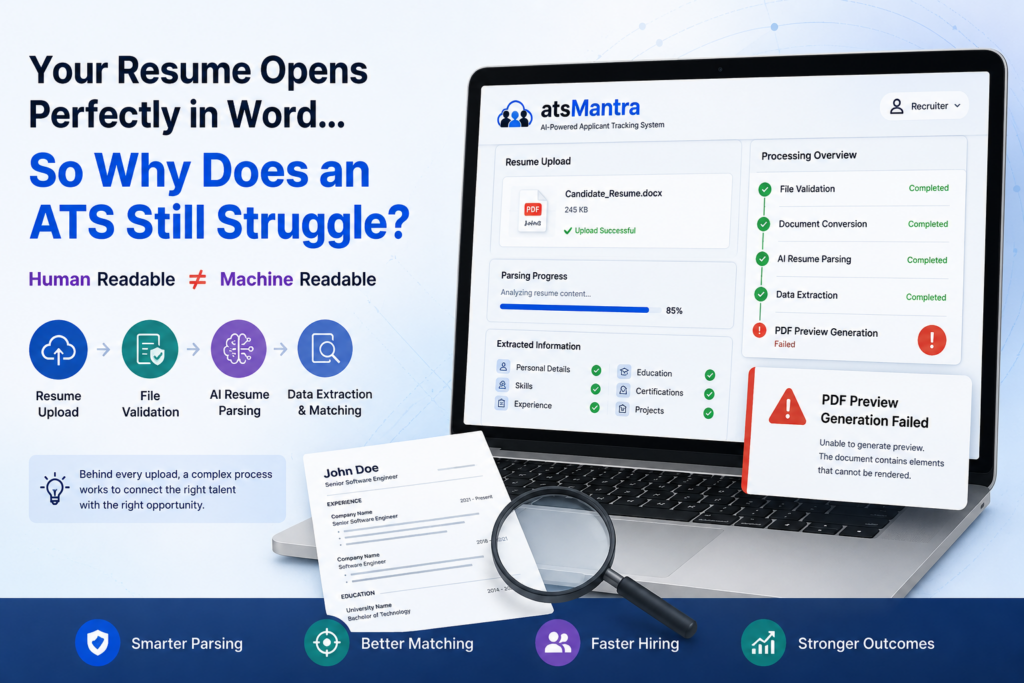
AI-powered ATS resume parsing dashboard processing a machine-readable resume with atsMantra
atsMantra, HR Recruitment, Human Resources

Your Resume Opens Perfectly in Microsoft Word… So Why Does an ATS Still Struggle?

If you’ve ever searched for resume writing tips online, you’ve probably come across the term “ATS-friendly resume.” The advice is almost always the same: Use a simple layout. Avoid too many graphics. Don’t use tables. Save your resume as a DOCX file. Include keywords from the job description. These are all good suggestions, but they don’t tell the complete story. While improving the resume processing engine behind atsMantra, our Applicant Tracking System (ATS), we recently came across a resume that taught us something interesting. The resume looked completely normal. It opened perfectly in Microsoft Word. It opened perfectly in LibreOffice. It passed every file integrity check. It could even be converted into another editable document format without any issues. But when our ATS tried to generate a PDF preview of the resume—a common process used by many recruitment software platforms—it simply refused to complete. That experience reminded us of an important fact. Just because a resume looks perfect to a human doesn’t always mean it’s easy for software to understand. What Does an Applicant Tracking System Actually Do? Many people believe an Applicant Tracking System is simply a place where recruiters store resumes. In reality, modern ATS software does much more. The moment you upload your resume, several automated processes begin working in the background. A typical workflow looks something like this: Resume Upload ↓ File Validation ↓ Document Processing ↓ Resume Parsing ↓ AI-Based Skill Extraction ↓ Experience & Education Detection ↓ Candidate Search & Matching ↓ Recruiter Review Every one of these steps depends on one thing: Your resume must be readable not only by people but also by software. Human-Friendly Doesn’t Always Mean Machine-Friendly When a recruiter opens your resume, they instantly understand the information because the human brain is incredibly good at interpreting layouts and formatting. Software works differently. An AI resume parser or Applicant Tracking System has to understand the structure of the document before it can identify important information such as: Name Contact details Skills Work experience Education Certifications Projects Achievements To do that, it also has to interpret: Fonts Headings Lists Tables Images Document styles Hidden formatting Metadata The more complex a document becomes, the harder it can be for software to process consistently. Fortunately, modern AI has become much better at understanding resumes, but even the best systems occasionally come across documents that present unexpected challenges. Why Resume Formatting Still Matters One of the biggest misconceptions is that ATS-friendly only means adding the right keywords. Keywords are important, but they are only one part of the equation. Your resume should also be: Easy to read Properly structured Consistently formatted Free from unnecessary formatting complexity A resume that has been edited repeatedly over several years, copied between multiple templates, or built using excessive formatting may still look perfect on screen while becoming much harder for software to process. Why This Matters for Recruiters Modern recruitment teams receive hundreds—or even thousands—of resumes for a single hiring campaign. To manage this volume efficiently, ATS platforms rely on automation. Today’s recruitment software doesn’t simply store resumes. It can: Generate resume previews Extract candidate information Parse work experience Identify skills Match candidates against job descriptions Perform AI-powered resume screening Enable advanced candidate search If a resume cannot be processed correctly, some of these automated features may not work as effectively. Thankfully, situations like this are rare, but they highlight why document quality is just as important as document design. How to Make Your Resume More ATS-Friendly Whether you’re actively looking for a job or simply keeping your resume updated, following a few simple practices can improve compatibility with almost every Applicant Tracking System. ✔ Use a recent version of Microsoft Word or another reliable document editor. ✔ Keep formatting clean and consistent. ✔ Avoid unnecessary graphics, floating text boxes, and decorative elements. ✔ Use commonly available fonts. ✔ Save a fresh copy instead of continuously editing the same document for years. ✔ Always review both the DOCX and PDF versions before submitting your application. These simple steps improve both readability and machine compatibility. The Future Is About Machine-Readable Resumes As Artificial Intelligence becomes a bigger part of recruitment, resume processing is evolving rapidly. Today’s AI-powered Applicant Tracking Systems don’t just search for keywords. They understand context, identify skills, analyse experience, and help recruiters find the right candidates much faster. But every AI system still depends on one thing: A well-structured, machine-readable document. Perhaps it’s time we stop thinking only about creating an ATS-friendly resume. Instead, we should focus on creating machine-readable resumes—documents that are easy for recruiters to read and equally easy for modern recruitment software and AI to understand. Final Thoughts The resume that inspired this article eventually taught us something much more valuable than a technical lesson. It reminded us that every resume is unique. Behind every upload is a document created using different templates, different software, and different editing habits. Building an Applicant Tracking System that can successfully process this incredible variety is far more challenging than it appears—and that’s exactly the kind of challenge we enjoy solving at RARR Technologies. Every edge case helps us improve atsMantra, making it smarter, more reliable, and better prepared for the diverse resumes that recruiters receive every day. Nishant Kapoor July 30, 2026 atsMantra, HR Recruitment, Human Resources Nishant KapoorNishant Kapoor leads IT and Customer Success at RARR Technologies, where he plays a key role in shaping atsMantra’s product experience and customer journey. With a strong focus on recruitment technology, digital workflows, and client success, he brings practical perspectives to industry challenges. On the atsMantra blog, Nishant shares insights not only on optimizing hiring processes but also on broader topics around business growth, productivity, and tech-driven innovation. www.rarrtech.com

Scroll to Top