


Author name: Rohit Gulati

Rohit Gulati is the Founder & Director of RARR Technologies Pvt. Ltd. With years of experience implementing ERP, HRTech, PMIS, and enterprise software solutions, he believes successful digital transformation starts with people, not software.

Avatar photo
Recruitment Insights Reading Time 7 Minutes
atsMantra, HR Recruitment, Human Resources

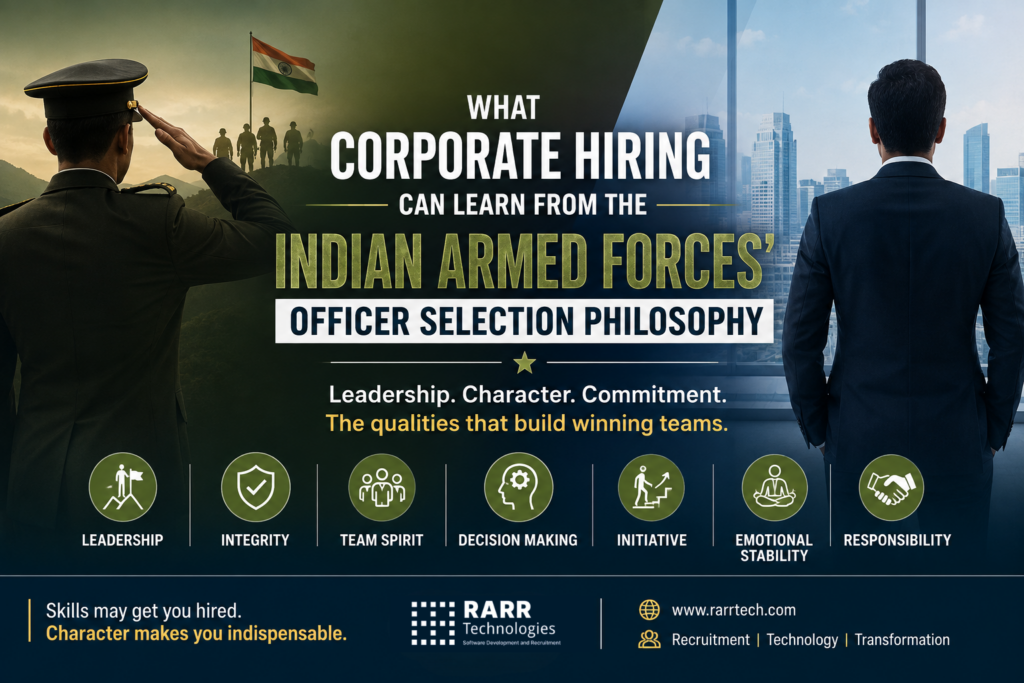
What Corporate Hiring Can Learn from the Indian Armed Forces’ Officer Selection Philosophy

Hiring Has Never Been Easy Every organization wants professionals who are technically competent, dependable, adaptable, and capable of leading teams through uncertainty. Yet, despite advanced hiring tools, structured interviews, psychometric tests, and AI-assisted screening, companies continue to make expensive hiring mistakes. The question is: Are we evaluating the right qualities? Interestingly, one of the most respected leadership selection systems already exists—not in the corporate world, but in the Indian Armed Forces.   The Written Examination Is Only the Beginning Every year, thousands of young Indians aspire to become commissioned officers through examinations such as the National Defence Academy (NDA) and Combined Defence Services (CDS). But clearing the written examination does not make someone an officer. It merely qualifies the candidate for the next stage—the Services Selection Board (SSB). Over several days, candidates participate in psychological assessments, group tasks, outdoor leadership exercises, interviews, and team-based problem-solving activities. The purpose is not simply to identify intelligent candidates. The objective is to identify individuals who can lead others, make decisions, work in teams, and perform effectively under challenging circumstances. And that distinction makes all the difference.   Skills Are Evaluated. Character Is Observed. The SSB selection philosophy places significant emphasis on Officer Like Qualities (OLQs). These include qualities such as: Effective Intelligence Initiative Reasoning Ability Self-Confidence Sense of Responsibility Decision-Making Courage Communication Team Spirit Emotional Stability Determination Integrity These qualities cannot be fully understood through a résumé. They become visible through behaviour, decisions, consistency, communication, and interactions with others. Perhaps that is why the assessment process extends beyond a conventional interview. Instead of asking only what a candidate knows, it attempts to understand how the candidate thinks, behaves, responds, and works with others.   Corporate Hiring Has a Different Bias Most organizations evaluate candidates using parameters such as: Educational qualifications Technical skills Certifications Domain expertise Years of experience Previous job responsibilities All of these are important. But they primarily answer one question: “Can this candidate perform today’s job?” There is another question that is equally important: “Can this individual grow into tomorrow’s leader?” That second question is often harder to evaluate. A candidate may have an impressive résumé but struggle with accountability, collaboration, adaptability, or decision-making. Another candidate may have a less impressive profile but demonstrate curiosity, ownership, resilience, and the ability to learn quickly. This is where traditional hiring can miss potential.   The AI Era Demands a Different Hiring Philosophy Artificial Intelligence is changing the workplace faster than many organizations anticipated. Programming languages evolve. Frameworks become obsolete. Tools change. Job roles themselves are being redesigned. In such an environment, hiring solely for today’s technical requirements can become risky. However, qualities such as ownership, judgment, integrity, adaptability, resilience, curiosity, and leadership remain valuable regardless of how technology changes. As technology becomes increasingly accessible, uniquely human qualities can become an even stronger competitive advantage. Organizations that hire only for technical skills may build capable teams. Organizations that also hire for character can build enduring institutions. What Can Corporate Hiring Learn from SSB? Corporate organizations and the Armed Forces serve very different purposes. Their selection systems cannot—and should not—be identical. However, the philosophy behind leadership assessment offers valuable lessons for corporate recruitment. Instead of relying entirely on résumé-based evaluation and conventional interviews, organizations could explore questions such as: Does the candidate naturally take ownership? Do they wait for instructions, or do they proactively identify and solve problems? Can they influence a team without formal authority? Leadership is not always about designation. Sometimes, the strongest indicator of leadership is the ability to influence, collaborate, and bring people together without relying on hierarchy. How do they behave under pressure? A candidate’s response to uncertainty, setbacks, deadlines, and difficult situations can reveal qualities that a résumé cannot. Do they demonstrate integrity when faced with difficult choices? Technical competence can create performance. Integrity creates trust. Are they willing to learn beyond their comfort zone? In a rapidly changing workplace, the ability to learn and adapt can be more valuable than knowing a particular tool today.   Hiring for Potential Creates Long-Term Value Throughout my journey in recruitment, I have seen candidates with exceptional technical profiles struggle because they lacked accountability or adaptability. At the same time, I have seen candidates with average résumés outperform expectations because they possessed curiosity, ownership, resilience, and a willingness to learn. This leads to an important distinction: Skills can be taught. Experience grows with time. But character is much harder to develop. That is why hiring should evaluate both competence and potential. A strong recruitment process should not only identify whether someone can perform a role today. It should also provide signals about whether that person can grow, adapt, take responsibility, and contribute meaningfully tomorrow.   From “Can They Do the Job?” to “Can We Trust Them With Responsibility?” The future of hiring may not be about replacing technical assessments with behavioural assessments. It may be about combining both. Technical skills tell us whether a candidate can perform specific tasks. Behavioural and leadership assessments can help us understand how that candidate may respond when the situation becomes uncertain, difficult, or unfamiliar. The strongest hiring decisions therefore consider both: Competence + Character Skills + Potential Experience + Adaptability Performance Today + Leadership Tomorrow   Final Thoughts The Indian Armed Forces have refined their officer selection philosophy over decades to identify individuals capable of leading under demanding circumstances. Corporate hiring does not need to replicate that process. But it can certainly learn from its underlying philosophy. Perhaps the future of recruitment lies not only in asking: “What skills does this candidate possess?” but also: “Can this person be trusted when the responsibility is theirs?” Because great organizations are not built merely by skilled professionals. They are built by people whose character inspires confidence long before their résumé does.   The Hiring Question Worth Asking Before making your next hiring decision, ask yourself: Are we hiring only for what the candidate can do—or also for who the candidate can become? Rohit Gulati August 17, 2026


ERP Implementation

Why ERP Implementations Fail: The Most Overlooked Step is User Adoption

The “Warm the Cup” Philosophy for Successful ERP Implementation When organizations decide to implement an Enterprise Resource Planning (ERP) system, discussions usually revolve around software features, implementation timelines, integrations, cloud infrastructure, and budgets. Ironically, the factor that determines the success of an ERP implementation is rarely discussed. It isn’t the software. It isn’t the implementation partner. It isn’t even the budget. It’s the people who will use the ERP every single day. Over the years, while implementing ERP solutions across different industries, we’ve observed one consistent pattern: Organizations that prepare their people before implementing the software almost always achieve better outcomes than those that focus only on technology. At RARR Technologies, we call this philosophy “Warming the Cup.” What Does “Warm the Cup” Mean? Imagine someone serving hot tea in a freezing-cold cup. The tea immediately loses its warmth. Sometimes, the sudden temperature difference may even crack the cup. Experienced tea lovers know the secret: Warm the cup first. ERP implementation works in exactly the same way. Before configuring workflows… Before importing data… Before training users… The organization must prepare itself for change. Employees should understand why the ERP is being introduced before learning how to use it. Only then does technology begin to create value. Technology Doesn’t Fail. Adoption Does. Many organizations believe ERP implementation is primarily an IT project. It isn’t. It is a business transformation initiative. An ERP changes: How departments communicate How approvals happen How inventory is tracked How finance operates How information flows across the organization Naturally, such change creates uncertainty. Employees begin asking questions like: Will this increase my workload? Will every mistake become visible? Will management monitor everything? Why should we change something that already works? These concerns are completely natural. People are not resisting software. They are resisting uncertainty. Leadership Creates Momentum One implementation completely changed our understanding of ERP success. Technically, everything was progressing according to plan. Meetings were happening. Training sessions were completed. Configurations were finished. Yet, the project struggled to move forward. The reason became obvious. Middle management viewed the ERP as another task competing with their daily responsibilities. The urgency simply wasn’t there. Everything changed when the Managing Director personally took ownership of the project. Instead of reviewing technical reports, he: Explained why the ERP mattered. Removed organizational bottlenecks. Encouraged every department to participate. The atmosphere changed almost immediately. Decisions became faster. Departments collaborated better. Users became more engaged. The software hadn’t changed. Leadership had. That experience taught us an important lesson: ERP implementation doesn’t begin when software is installed. It begins when leadership creates belief. Vision Travels Faster Than Software Another implementation involved rolling out an ERP across more than 4,000 operational sites. On paper, it appeared to be one of our most challenging projects. Surprisingly, it became one of the smoothest. Why? The organization appointed a dedicated ERP coordinator who became the bridge between users, management, and our implementation team. More importantly, leadership had already established a clear vision. Employees understood that the ERP would: Simplify daily work Improve visibility Eliminate repetitive manual tasks Support business growth Nobody felt the ERP was being forced upon them. Instead, they felt they were becoming part of a larger transformation. Technology scaled because belief had already scaled. How to “Warm the Cup” Before ERP Go-Live 1. Explain the “Why” Don’t begin by talking about software. Begin by talking about business problems and the outcomes the ERP will deliver. 2. Make Users Stakeholders Invite employees to help design workflows. People naturally support what they help create. 3. Build Department Champions Every department has individuals who embrace change. Train them first. They become ambassadors who help others adopt the system. 4. Address Fear Openly Resistance is normal. Ignoring it isn’t. Listen before you train. Answer concerns honestly and build confidence. 5. Celebrate Small Wins Don’t wait until the project is complete. Celebrate every milestone. Momentum encourages adoption. The Real Go-Live Many organizations believe Go-Live happens when the ERP server becomes operational. We think differently. The real Go-Live happens when employees stop saying: “Management’s ERP” and begin saying: “Our ERP.” That is the moment implementation truly succeeds. Final Thoughts Software can automate processes. It cannot build ownership. Technology can generate reports. It cannot create trust. Dashboards improve visibility. They cannot create commitment. That responsibility belongs to leadership. So before discussing modules… Before planning integrations… Before migrating data… Warm the Cup. Because once people are ready, technology naturally follows. Key Takeaways ERP success depends more on people than software. User adoption is the biggest predictor of implementation success. Leadership involvement creates momentum and trust. Early communication reduces resistance to change. Successful ERP implementation begins before Go-Live. Rohit Gulati July 21, 2026 ERP Implementation Rohit GulatiRohit Gulati is the Founder & Director of RARR Technologies Pvt. Ltd. With years of experience implementing ERP, HRTech, PMIS, and enterprise software solutions, he believes successful digital transformation starts with people, not software. www.rarrtech.com

pexels fauxels 3182792 23
HR Recruitment

The Freelance Recruiter’s Blueprint for Success

Introduction: Freelance recruiting offers an enticing opportunity for individuals to leverage their skills and expertise in the talent acquisition field while enjoying the flexibility of self-employment. However, being a successful freelance recruiter requires a unique set of qualities and strategies to thrive in a competitive market. In this write-up, we will explore the key ingredients necessary to excel as a freelance recruiter. Expertise and Specialization: To stand out in the freelance recruiting arena, it is essential to develop expertise in a specific industry or niche. Specializing allows you to understand the nuances, requirements, and trends of that industry better. Clients seek recruiters who possess deep knowledge and can provide valuable insights and guidance throughout the hiring process. Strong Network and Relationship Building: Building a robust professional network is crucial for freelance recruiters. It is essential to establish connections with both clients and potential candidates. Actively participate in industry events, join professional associations, and leverage social media platforms to expand your network. Cultivate relationships by maintaining regular contact and offering assistance or insights whenever possible. Effective Communication Skills: Successful freelance recruiters possess excellent communication skills. This includes active listening, clear and concise verbal and written communication, and the ability to build rapport and trust with clients and candidates. Being able to articulate job requirements, expectations, and company culture effectively is vital for attracting and matching the right candidates. Adaptability and Flexibility: Freelance recruiters operate in a dynamic and ever-changing environment. The ability to adapt to new technologies, trends, and market shifts is critical. Stay updated on the latest recruitment tools, strategies, and industry developments. Being flexible in accommodating client needs and adjusting your approach to different hiring situations will set you apart from the competition. Strong Time Management and Organizational Skills: As a freelance recruiter, you will handle multiple clients and projects simultaneously. Effective time management and organizational skills are essential to ensure that you meet deadlines and deliver quality results. Utilize productivity tools, establish a structured workflow, and prioritize tasks to optimize your efficiency. Commitment to Ethics and Professionalism: Maintaining a high standard of ethics and professionalism is paramount in freelance recruiting. Upholding confidentiality, treating candidates and clients with respect, and conducting business with integrity are fundamental principles. Building a reputation for being trustworthy and reliable will not only attract clients but also lead to repeat business and referrals. Continuous Learning and Improvement: The recruitment landscape is constantly evolving. Successful freelance recruiters embrace a growth mindset and actively seek opportunities to learn and improve their skills. Stay updated on industry best practices, attend training sessions, and invest in professional development to enhance your knowledge and stay ahead of the curve. Conclusion: Becoming a successful freelance recruiter requires a combination of expertise, networking, communication skills, adaptability, time management, professionalism, and a commitment to continuous learning. By cultivating these essential ingredients, you can position yourself as a valuable and sought-after professional in the freelance recruitment industry. Remember, success in freelance recruiting comes with dedication, perseverance, and a passion for connecting exceptional talent with the right opportunities. Rohit GulatiRohit Gulati is the Founder & Director of RARR Technologies Pvt. Ltd. With years of experience implementing ERP, HRTech, PMIS, and enterprise software solutions, he believes successful digital transformation starts with people, not software. www.rarrtech.com

Scroll to Top