


Author name: Nishant Kapoor

Nishant Kapoor leads IT and Customer Success at RARR Technologies, where he plays a key role in shaping atsMantra’s product experience and customer journey. With a strong focus on recruitment technology, digital workflows, and client success, he brings practical perspectives to industry challenges. On the atsMantra blog, Nishant shares insights not only on optimizing hiring processes but also on broader topics around business growth, productivity, and tech-driven innovation.

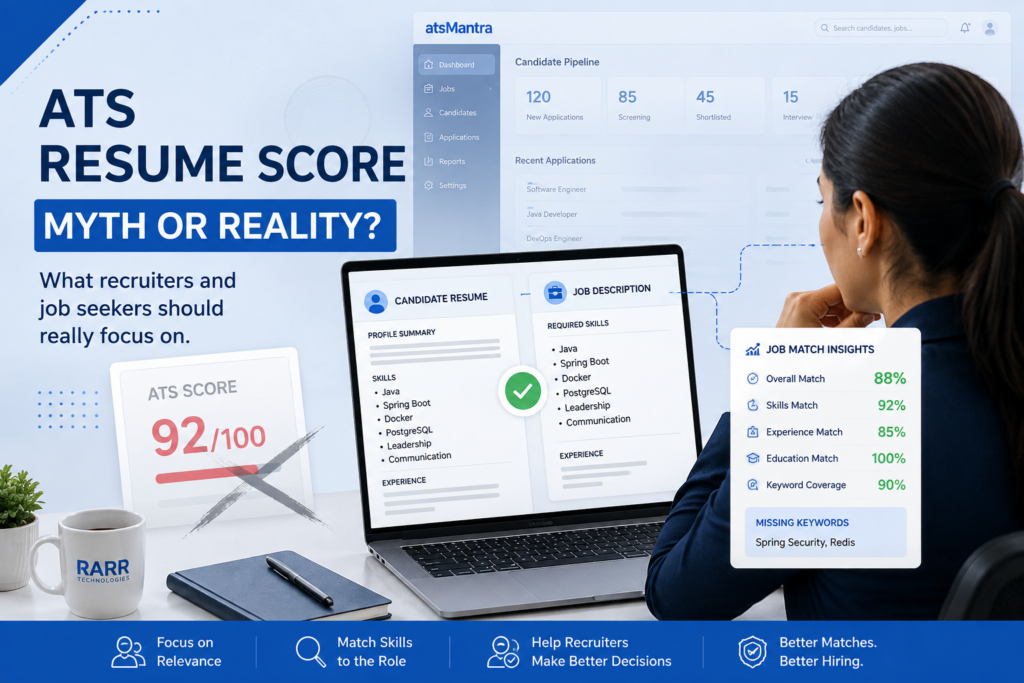
Recruiter comparing a candidate resume with a job description to illustrate the truth behind ATS resume scores and resume matching.
atsMantra, HR Recruitment

ATS Resume Score: Myth or Reality? What Every Recruiter and Job Seeker Should Know

Recently, while demonstrating atsMantra, our AI-powered hiring suite, to a prospective client, I was asked a question that made me pause. “Does your ATS provide an ATS Resume Score?” Before I could answer, the client explained why it mattered. Their company recruits IT professionals for overseas clients. Many of those clients use an Applicant Tracking System (ATS) to manage recruitment, and they wanted to ensure that every resume they submitted had a good “ATS Score.” They believed that a higher score would increase the candidate’s chances of getting shortlisted. It wasn’t the first time I had heard this question. In fact, over the last few years, the term “ATS Score” has become incredibly popular among recruiters and job seekers alike. The conversation stayed with me long after the demo had ended because it raised an important question. Is there really something called an ATS Resume Score, or have we all started believing in something that doesn’t actually exist? After spending years working with recruitment technology, I believe the answer is somewhere in the middle. Where Did the Idea of an ATS Score Come From? If you’ve searched online for resume tips, you’ve probably come across websites that promise to “check your ATS score” or “increase your ATS score to 90+.” These platforms usually ask you to upload your resume and, in many cases, compare it with a job description. Within seconds, they produce a score out of 100 along with suggestions for improvement. Because these tools are so popular, many candidates assume that this is exactly how every company’s ATS evaluates resumes. That’s where the misunderstanding begins. Does an ATS Really Give Your Resume a Score? The simple answer is no—not in the way most people think. There is no universal ATS score that every Applicant Tracking System calculates. Different companies use different ATS platforms, and even companies using the same software often configure it differently. Some organisations rely heavily on recruiter searches. Others use screening questions. Some use AI-assisted recommendations, while many simply organise applications so recruiters can review them efficiently. In other words, there is no single number that determines whether your resume will be accepted or rejected. The “ATS Score” that many people talk about is usually created by a resume optimisation tool—not by the employer’s ATS. So, What Does an ATS Actually Do? At its core, an Applicant Tracking System is designed to make recruitment easier. It helps recruiters: Collect and organise applications. Extract information from resumes. Search candidates using skills, job titles or experience. Filter applicants based on hiring requirements. Track candidates throughout the recruitment process. Modern ATS platforms may also use artificial intelligence to help recruiters identify relevant candidates, but their primary purpose is to assist recruiters—not replace them. Ultimately, hiring decisions are still made by people. Why Matching the Job Description Matters Let’s look at a simple example. Imagine a company is hiring a Java Backend Developer. The job description mentions: Java 17 Spring Boot PostgreSQL Docker Kubernetes Now imagine two candidates with almost identical experience. The first candidate writes: “Worked on enterprise backend applications using modern technologies.” The second candidate writes: “Developed Java 17 and Spring Boot microservices using PostgreSQL, Docker and Kubernetes.” Both candidates may have done exactly the same work. However, the second resume makes those skills much easier to identify. When recruiters search their ATS using keywords like Spring Boot or Docker, the second candidate is far more likely to appear in the results. That isn’t because of an ATS score. It’s because the resume clearly communicates relevant skills. What Candidates Should Really Focus On Instead of chasing an arbitrary score, candidates should focus on writing resumes that accurately represent their experience while matching the role they are applying for. A good resume should: Be tailored for the specific job. Include relevant skills naturally rather than stuffing keywords. Use clear section headings such as Experience, Skills and Education. Highlight measurable achievements wherever possible. Avoid overly complicated layouts that make information difficult to read. Be honest and easy to understand. A resume isn’t just being read by software. It’s being read by recruiters, hiring managers and interviewers. The goal isn’t to impress an algorithm. The goal is to communicate your value clearly. A Better Way to Think About It Perhaps we’ve been asking the wrong question all along. Instead of asking: “What is my ATS Score?” Candidates should ask: “Does my resume clearly demonstrate that I’m the right person for this job?” Those are two very different questions. A resume can receive an excellent score from an online tool and still fail to impress a recruiter. Equally, a thoughtfully written resume may not score perfectly on one website yet still result in interviews because it speaks directly to the employer’s requirements. What Recruitment Technology Should Really Do Working closely with recruiters over the years has taught me that they aren’t looking for another number. They’re looking for confidence. They want to know whether a candidate genuinely fits the role, what skills might be missing, whether the experience aligns with the position and whether the candidate deserves a conversation. That’s where modern recruitment technology can make a real difference. Rather than producing a mysterious score out of 100, recruitment platforms should help recruiters make better decisions by comparing resumes with job descriptions, identifying strengths and gaps, and presenting meaningful insights that save time without hiding how those conclusions were reached. Final Thoughts The phrase “ATS Resume Score” isn’t entirely a myth—but it isn’t entirely real either. The score itself usually comes from resume optimisation tools, not from the ATS used by employers. What is real is the importance of writing a resume that is relevant, clear and tailored to the role you’re applying for. So, if you’re a job seeker, don’t lose sleep trying to reach an arbitrary score of 90 or above. Spend that time understanding the job description, highlighting your genuine experience and explaining your achievements in a way that’s easy for both recruiters and technology to understand.
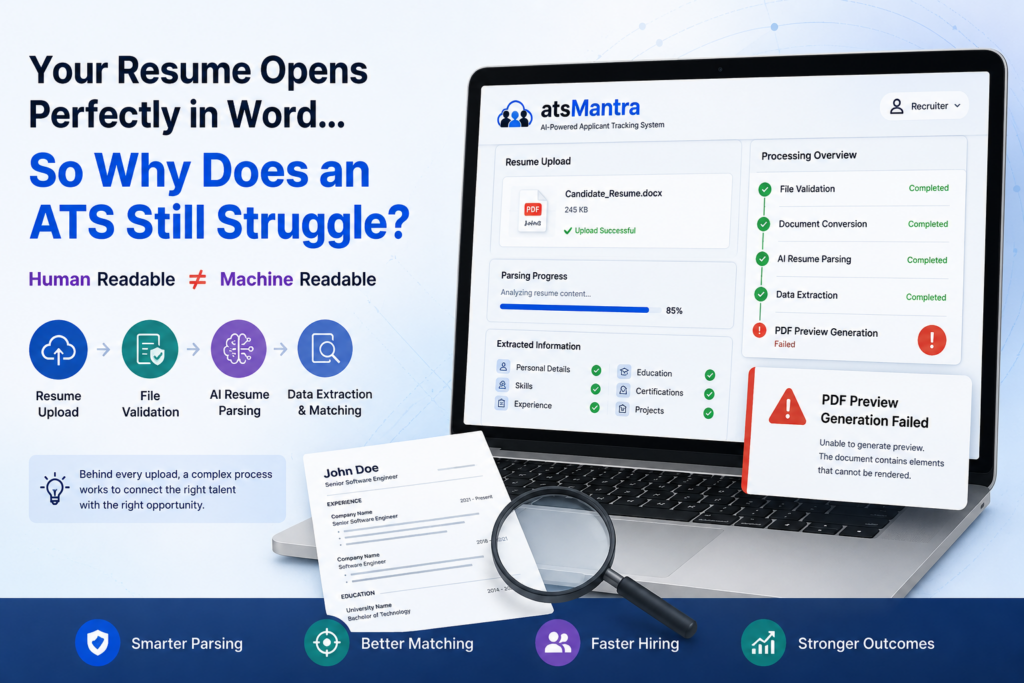

AI-powered ATS resume parsing dashboard processing a machine-readable resume with atsMantra
atsMantra, HR Recruitment, Human Resources

Your Resume Opens Perfectly in Microsoft Word… So Why Does an ATS Still Struggle?

If you’ve ever searched for resume writing tips online, you’ve probably come across the term “ATS-friendly resume.” The advice is almost always the same: Use a simple layout. Avoid too many graphics. Don’t use tables. Save your resume as a DOCX file. Include keywords from the job description. These are all good suggestions, but they don’t tell the complete story. While improving the resume processing engine behind atsMantra, our Applicant Tracking System (ATS), we recently came across a resume that taught us something interesting. The resume looked completely normal. It opened perfectly in Microsoft Word. It opened perfectly in LibreOffice. It passed every file integrity check. It could even be converted into another editable document format without any issues. But when our ATS tried to generate a PDF preview of the resume—a common process used by many recruitment software platforms—it simply refused to complete. That experience reminded us of an important fact. Just because a resume looks perfect to a human doesn’t always mean it’s easy for software to understand. What Does an Applicant Tracking System Actually Do? Many people believe an Applicant Tracking System is simply a place where recruiters store resumes. In reality, modern ATS software does much more. The moment you upload your resume, several automated processes begin working in the background. A typical workflow looks something like this: Resume Upload ↓ File Validation ↓ Document Processing ↓ Resume Parsing ↓ AI-Based Skill Extraction ↓ Experience & Education Detection ↓ Candidate Search & Matching ↓ Recruiter Review Every one of these steps depends on one thing: Your resume must be readable not only by people but also by software. Human-Friendly Doesn’t Always Mean Machine-Friendly When a recruiter opens your resume, they instantly understand the information because the human brain is incredibly good at interpreting layouts and formatting. Software works differently. An AI resume parser or Applicant Tracking System has to understand the structure of the document before it can identify important information such as: Name Contact details Skills Work experience Education Certifications Projects Achievements To do that, it also has to interpret: Fonts Headings Lists Tables Images Document styles Hidden formatting Metadata The more complex a document becomes, the harder it can be for software to process consistently. Fortunately, modern AI has become much better at understanding resumes, but even the best systems occasionally come across documents that present unexpected challenges. Why Resume Formatting Still Matters One of the biggest misconceptions is that ATS-friendly only means adding the right keywords. Keywords are important, but they are only one part of the equation. Your resume should also be: Easy to read Properly structured Consistently formatted Free from unnecessary formatting complexity A resume that has been edited repeatedly over several years, copied between multiple templates, or built using excessive formatting may still look perfect on screen while becoming much harder for software to process. Why This Matters for Recruiters Modern recruitment teams receive hundreds—or even thousands—of resumes for a single hiring campaign. To manage this volume efficiently, ATS platforms rely on automation. Today’s recruitment software doesn’t simply store resumes. It can: Generate resume previews Extract candidate information Parse work experience Identify skills Match candidates against job descriptions Perform AI-powered resume screening Enable advanced candidate search If a resume cannot be processed correctly, some of these automated features may not work as effectively. Thankfully, situations like this are rare, but they highlight why document quality is just as important as document design. How to Make Your Resume More ATS-Friendly Whether you’re actively looking for a job or simply keeping your resume updated, following a few simple practices can improve compatibility with almost every Applicant Tracking System. ✔ Use a recent version of Microsoft Word or another reliable document editor. ✔ Keep formatting clean and consistent. ✔ Avoid unnecessary graphics, floating text boxes, and decorative elements. ✔ Use commonly available fonts. ✔ Save a fresh copy instead of continuously editing the same document for years. ✔ Always review both the DOCX and PDF versions before submitting your application. These simple steps improve both readability and machine compatibility. The Future Is About Machine-Readable Resumes As Artificial Intelligence becomes a bigger part of recruitment, resume processing is evolving rapidly. Today’s AI-powered Applicant Tracking Systems don’t just search for keywords. They understand context, identify skills, analyse experience, and help recruiters find the right candidates much faster. But every AI system still depends on one thing: A well-structured, machine-readable document. Perhaps it’s time we stop thinking only about creating an ATS-friendly resume. Instead, we should focus on creating machine-readable resumes—documents that are easy for recruiters to read and equally easy for modern recruitment software and AI to understand. Final Thoughts The resume that inspired this article eventually taught us something much more valuable than a technical lesson. It reminded us that every resume is unique. Behind every upload is a document created using different templates, different software, and different editing habits. Building an Applicant Tracking System that can successfully process this incredible variety is far more challenging than it appears—and that’s exactly the kind of challenge we enjoy solving at RARR Technologies. Every edge case helps us improve atsMantra, making it smarter, more reliable, and better prepared for the diverse resumes that recruiters receive every day. Nishant Kapoor July 30, 2026 atsMantra, HR Recruitment, Human Resources Nishant KapoorNishant Kapoor leads IT and Customer Success at RARR Technologies, where he plays a key role in shaping atsMantra’s product experience and customer journey. With a strong focus on recruitment technology, digital workflows, and client success, he brings practical perspectives to industry challenges. On the atsMantra blog, Nishant shares insights not only on optimizing hiring processes but also on broader topics around business growth, productivity, and tech-driven innovation. www.rarrtech.com

HR Recruitment, Human Resources

Decoding Digital Personal Data Protection Bill 2023 (DPDPB)

Introduction: In an era defined by unprecedented technological advancements and the widespread use of digital platforms, the need to protect personal data has taken center stage. India, as one of the world’s largest and fastest-growing digital economies, has recognized the urgency of this matter and introduced the Digital Personal Data Protection Bill. This landmark legislation aims to establish a comprehensive framework for safeguarding individual privacy and ensuring responsible data management in the digital realm. The Digital Personal Data Protection Bill was introduced as a response to growing concerns about the misuse of personal data, data breaches, and the need to align India’s data protection standards with international norms, such as the General Data Protection Regulation (GDPR) in the European Union. The bill reflects India’s commitment to providing its citizens with a robust legal foundation for digital privacy rights. Key Provisions of the Bill An applicant tracking system, or ATS, is a tool that enables your company to track and measure each step of its recruitment process. An ATS collects and stores information about your applicants, such as where they were sourced and which stage of the application process they are at. Modern applicant tracking systems are more than a glorified spreadsheet. Today’s ATS includes end-to-end hiring solutions, like scheduling tools, candidate relationship management (CRM) software, and seamless integration with your human resource information system. An ATS transforms your recruitment process into a streamlined, efficient, and technologically advanced operation.  How do applicant tracking systems work?  Candidates are looking for application processes that are easy and user-friendly. The best applicant tracking systems allow people to easily apply for a position via any device without needing to log in.  This means that employers benefit from securing a larger pool of applicants, who can then be tagged a labelled accordingly, based on the info in their resumes.  More specifically, what are the benefits of an applicant tracking system?  Streamlining your hiring process becomes seamless with the implementation of an Applicant Tracking System (ATS). Imagine navigating through the pain points of your hiring workflow without a robust platform in place. In the absence of an efficient system, you might encounter inconsistencies in candidate tracking and misalignments among your hiring team, particularly if you rely on spreadsheets and emails. Building a robust talent pool and identifying top-notch candidates may prove challenging. The entire hiring journey, from job postings to interview scheduling and offer issuance, could be needlessly prolonged and arduous.  However, life post-ATS implementation presents a markedly improved scenario.  A reliable ATS:  Building a robust professional network is crucial for freelance recruiters. It is essential to establish connections with both clients and potential candidates. Actively participate in industry events, join professional associations, and leverage social media platforms to expand your network. Cultivate relationships by maintaining regular contact and offering assistance or insights whenever possible. On the other side, a good ATS:  Nishant KapoorNishant Kapoor leads IT and Customer Success at RARR Technologies, where he plays a key role in shaping atsMantra’s product experience and customer journey. With a strong focus on recruitment technology, digital workflows, and client success, he brings practical perspectives to industry challenges. On the atsMantra blog, Nishant shares insights not only on optimizing hiring processes but also on broader topics around business growth, productivity, and tech-driven innovation. www.rarrtech.com

Scroll to Top