

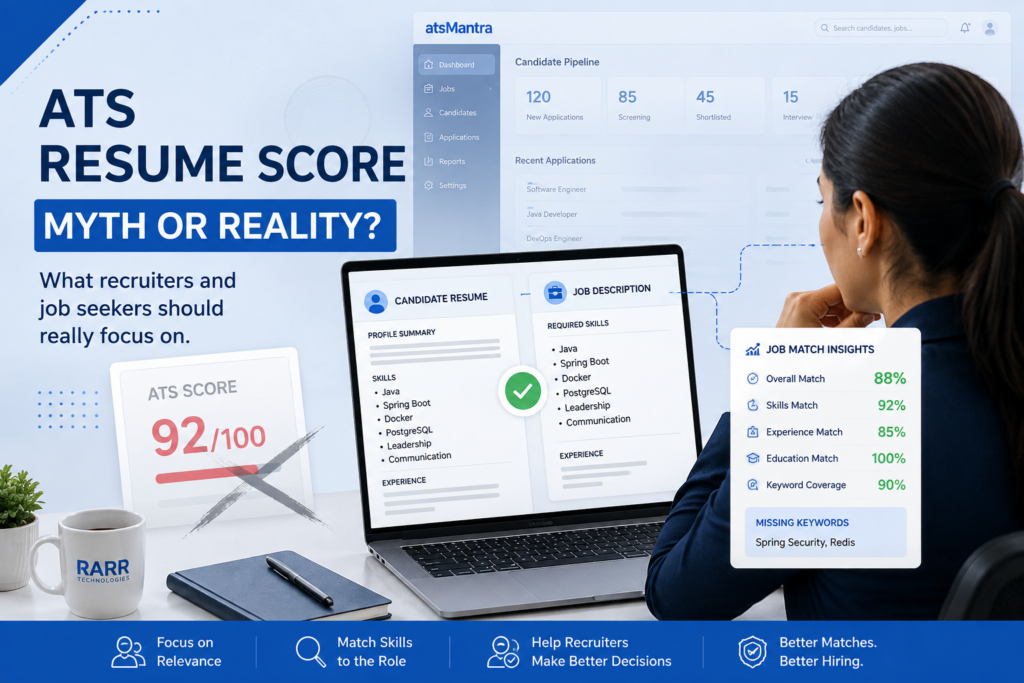
ATS Resume Score: Myth or Reality? What Every Recruiter and Job Seeker Should Know
Recently, while demonstrating atsMantra, our AI-powered hiring suite, to a prospective client, I was asked a question that made me pause. “Does your ATS provide an ATS Resume Score?” Before I could answer, the client explained why it mattered. Their company recruits IT professionals for overseas clients. Many of those clients use an Applicant Tracking System (ATS) to manage recruitment, and they wanted to ensure that every resume they submitted had a good “ATS Score.” They believed that a higher score would increase the candidate’s chances of getting shortlisted. It wasn’t the first time I had heard this question. In fact, over the last few years, the term “ATS Score” has become incredibly popular among recruiters and job seekers alike. The conversation stayed with me long after the demo had ended because it raised an important question. Is there really something called an ATS Resume Score, or have we all started believing in something that doesn’t actually exist? After spending years working with recruitment technology, I believe the answer is somewhere in the middle. Where Did the Idea of an ATS Score Come From? If you’ve searched online for resume tips, you’ve probably come across websites that promise to “check your ATS score” or “increase your ATS score to 90+.” These platforms usually ask you to upload your resume and, in many cases, compare it with a job description. Within seconds, they produce a score out of 100 along with suggestions for improvement. Because these tools are so popular, many candidates assume that this is exactly how every company’s ATS evaluates resumes. That’s where the misunderstanding begins. Does an ATS Really Give Your Resume a Score? The simple answer is no—not in the way most people think. There is no universal ATS score that every Applicant Tracking System calculates. Different companies use different ATS platforms, and even companies using the same software often configure it differently. Some organisations rely heavily on recruiter searches. Others use screening questions. Some use AI-assisted recommendations, while many simply organise applications so recruiters can review them efficiently. In other words, there is no single number that determines whether your resume will be accepted or rejected. The “ATS Score” that many people talk about is usually created by a resume optimisation tool—not by the employer’s ATS. So, What Does an ATS Actually Do? At its core, an Applicant Tracking System is designed to make recruitment easier. It helps recruiters: Collect and organise applications. Extract information from resumes. Search candidates using skills, job titles or experience. Filter applicants based on hiring requirements. Track candidates throughout the recruitment process. Modern ATS platforms may also use artificial intelligence to help recruiters identify relevant candidates, but their primary purpose is to assist recruiters—not replace them. Ultimately, hiring decisions are still made by people. Why Matching the Job Description Matters Let’s look at a simple example. Imagine a company is hiring a Java Backend Developer. The job description mentions: Java 17 Spring Boot PostgreSQL Docker Kubernetes Now imagine two candidates with almost identical experience. The first candidate writes: “Worked on enterprise backend applications using modern technologies.” The second candidate writes: “Developed Java 17 and Spring Boot microservices using PostgreSQL, Docker and Kubernetes.” Both candidates may have done exactly the same work. However, the second resume makes those skills much easier to identify. When recruiters search their ATS using keywords like Spring Boot or Docker, the second candidate is far more likely to appear in the results. That isn’t because of an ATS score. It’s because the resume clearly communicates relevant skills. What Candidates Should Really Focus On Instead of chasing an arbitrary score, candidates should focus on writing resumes that accurately represent their experience while matching the role they are applying for. A good resume should: Be tailored for the specific job. Include relevant skills naturally rather than stuffing keywords. Use clear section headings such as Experience, Skills and Education. Highlight measurable achievements wherever possible. Avoid overly complicated layouts that make information difficult to read. Be honest and easy to understand. A resume isn’t just being read by software. It’s being read by recruiters, hiring managers and interviewers. The goal isn’t to impress an algorithm. The goal is to communicate your value clearly. A Better Way to Think About It Perhaps we’ve been asking the wrong question all along. Instead of asking: “What is my ATS Score?” Candidates should ask: “Does my resume clearly demonstrate that I’m the right person for this job?” Those are two very different questions. A resume can receive an excellent score from an online tool and still fail to impress a recruiter. Equally, a thoughtfully written resume may not score perfectly on one website yet still result in interviews because it speaks directly to the employer’s requirements. What Recruitment Technology Should Really Do Working closely with recruiters over the years has taught me that they aren’t looking for another number. They’re looking for confidence. They want to know whether a candidate genuinely fits the role, what skills might be missing, whether the experience aligns with the position and whether the candidate deserves a conversation. That’s where modern recruitment technology can make a real difference. Rather than producing a mysterious score out of 100, recruitment platforms should help recruiters make better decisions by comparing resumes with job descriptions, identifying strengths and gaps, and presenting meaningful insights that save time without hiding how those conclusions were reached. Final Thoughts The phrase “ATS Resume Score” isn’t entirely a myth—but it isn’t entirely real either. The score itself usually comes from resume optimisation tools, not from the ATS used by employers. What is real is the importance of writing a resume that is relevant, clear and tailored to the role you’re applying for. So, if you’re a job seeker, don’t lose sleep trying to reach an arbitrary score of 90 or above. Spend that time understanding the job description, highlighting your genuine experience and explaining your achievements in a way that’s easy for both recruiters and technology to understand.